NEET Preparation Plan 2027: Complete Study, Revision & Test Strategy
A practical NEET Preparation Plan 2027 covering concept building, daily question practice, CBTs, NCERT, PYQs, mock tests, revision, workshops and final exam preparation.
Preparing for NEET is not simply a matter of completing Physics, Chemistry and Biology chapters. A serious NEET preparation plan has to coordinate concept learning, question practice, testing, error correction, revision and full-paper simulation throughout the preparation cycle.
For students targeting NEET 2027, the biggest advantage of starting early is not merely having more months available. It is having enough time to identify weak areas, practise repeatedly and return to the same concepts through multiple revision cycles.
Concept → Examples → Practice → Test → Analyse → Correct → Revise → Retest
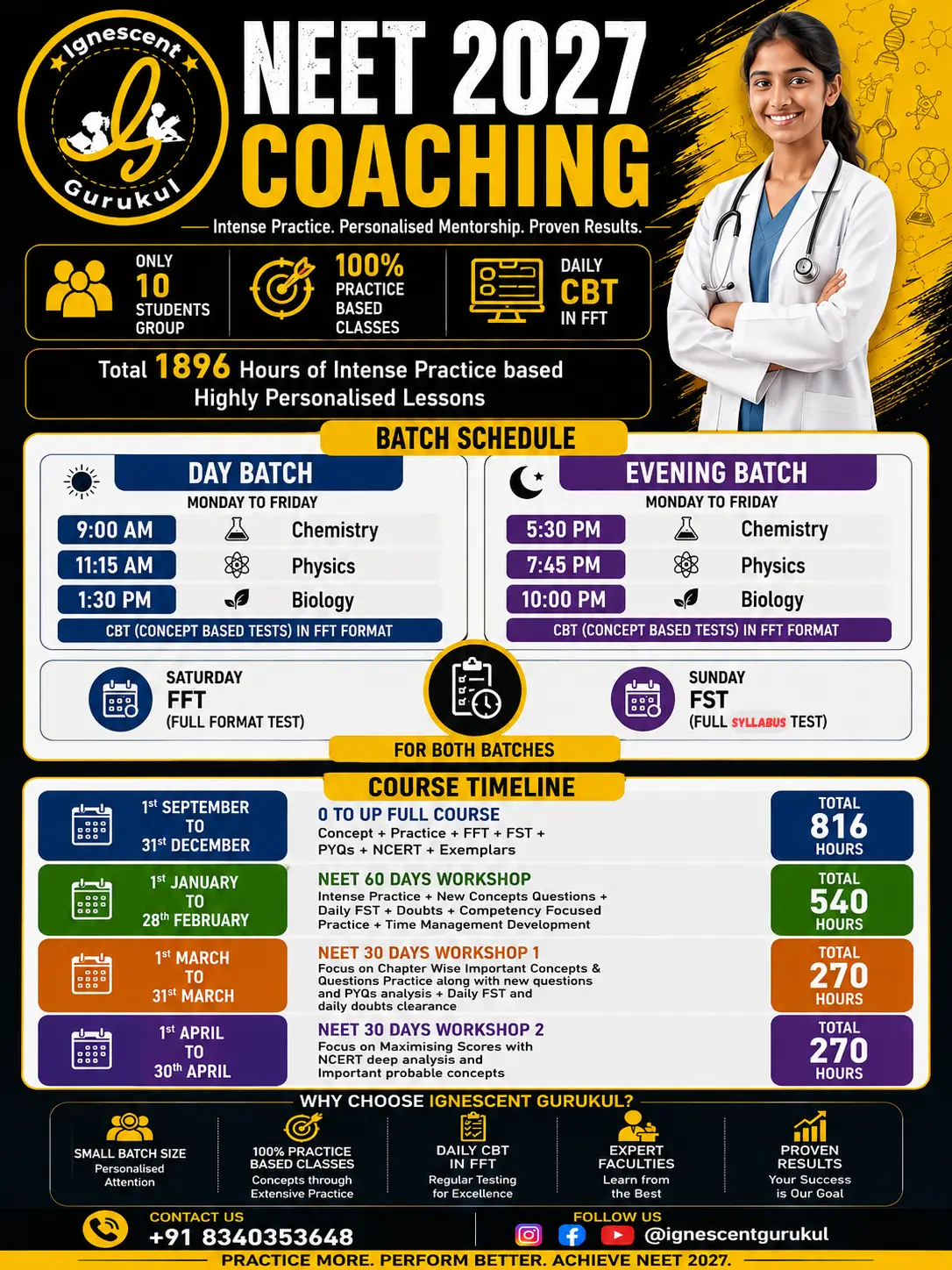
Ignescent Gurukul’s proposed NEET 2027 academic plan follows this practice-first philosophy. The detailed plan is organised around a 1,896-hour preparation framework, combining structured teaching, intensive practice, daily Concept Based Tests, FFT/FST testing, revision, workshops and exam-oriented preparation. :contentReference[oaicite:2]{index=2}
The exact NEET (UG) 2027 examination date, final information bulletin, application schedule and any changes to the examination pattern should be confirmed from the official National Testing Agency (NTA) notification when released. The NTA’s current public information pages are publishing NEET (UG) 2026 information, so students should not treat unofficial 2027 dates circulating online as confirmed. The NMC’s official syllabus resource should likewise be checked for the applicable syllabus. :contentReference[oaicite:3]{index=3}
NEET Preparation Plan 2027: What This Guide Covers
- How to structure NEET 2027 preparation from September 2026
- A month-wise preparation framework
- How to study Physics, Chemistry and Biology
- How daily CBTs and regular tests fit into preparation
- How to use NCERT and NEET PYQs effectively
- How to build revision cycles instead of leaving revision until the end
- How 60-day and 30-day intensive workshops can be used
- How to prepare for full-syllabus mock tests
- How to manage backlogs, errors and weak chapters
What Should a NEET Preparation Plan 2027 Include?
A useful NEET study plan should tell a student not only what to study but also when to practise, when to test, how to analyse mistakes and when to revise previously completed chapters.
A strong plan therefore needs five interconnected layers:
Concepts
Build the underlying Physics, Chemistry and Biology concepts before moving into intensive problem solving.
Practice
Convert concepts into solving ability through graded questions, examples, PYQs and chapter-level practice.
Testing
Use regular CBTs, chapter tests, full-format tests and full-syllabus tests to measure actual performance.
Analysis
Identify wrong, guessed, slow and repeatedly troublesome questions instead of merely recording a total score.
The 1,896-Hour NEET 2027 Preparation Plan
The detailed Ignescent Gurukul plan uses an approximately 1,896-hour academic framework extending from the initial preparation phase through intensive revision and final exam-oriented practice. The plan supplied by the coaching programme allocates 816 hours from September through December 2026, 540 hours for the January-February 60-day workshop, and two 270-hour 30-day workshop phases during March and April. :contentReference[oaicite:4]{index=4}
| Phase | Period | Planned Hours | Primary Objective |
|---|---|---|---|
| Foundation & Intensive Practice | 1 September – 31 December 2026 | 816 | Concept coverage + examples + intensive question practice + CBT + FFT/FST |
| 60 Days NEET Workshop | 1 January – 28 February 2027 | 540 | Intensive revision + NCERT + PYQs + testing + doubts + accuracy and time management |
| 30 Days NEET Workshop 1 | 1 March – 31 March 2027 | 270 | Chapter-by-chapter rapid practice, CBT and error correction |
| 30 Days NEET Workshop 2 | 1 April – 30 April 2027 | 270 | Final intensive revision, NCERT/PYQ/CFQ practice and score maximisation |
Total planned hours: 1,896.
The original plan also specifies an induction and academic introduction before the main preparation cycle begins, followed by the September through December concept-and-practice phase. :contentReference[oaicite:5]{index=5}
Phase 1: September to December 2026 — Build Concepts and Practice Intensively
The first major phase should not be treated as a simple syllabus completion period. Its purpose is to build a strong base while developing the habit of solving questions every day.
According to the detailed Ignescent Gurukul plan, the September-December period is allocated 816 hours and follows a weekday pattern of concepts, related examples, practice and a 75-question CBT, with FFT/FST testing scheduled at the weekend level. :contentReference[oaicite:6]{index=6}
How Students Should Use Phase 1
- Learn the concept actively rather than copying notes passively.
- Solve representative examples immediately after learning.
- Practise questions while the concept is still fresh.
- Attempt the daily CBT seriously rather than treating it as a formality.
- Record mistakes, guesses and questions that consume excessive time.
- Revise difficult concepts before beginning the next major topic.
The objective is to create a learning cycle in which every completed topic is immediately converted into solving ability and then checked through testing.
Daily NEET Study Strategy: Learn, Practise and Test
A common mistake in NEET preparation is separating studying and testing too far apart. A student may spend several days watching lectures or reading notes and only discover during a mock test that the concepts were not actually usable.
A more effective daily structure is:
The purpose of the daily test is not simply to produce a score. It is to identify learning gaps while the topic is still fresh enough to correct.
What to Record After Every Test
- Questions answered incorrectly
- Questions answered through guessing
- Questions that took too long
- Concepts that were forgotten
- Calculation or reading errors
- Repeated mistakes from earlier tests
How to Prepare Physics for NEET 2027
NEET Physics preparation should combine conceptual understanding with repeated numerical application. Memorising formulas without understanding when and why they apply is unlikely to produce consistent performance across different question styles.
A useful Physics cycle is:
Concept → Formula Meaning → Derivation/Relationship → Examples → Numerical Practice → PYQs → CBT → Chapter Test → Revision
Physics Preparation Priorities
- Understand the physical meaning of formulae instead of memorising isolated expressions.
- Build strong fundamentals in Mechanics, Electrodynamics, Optics and Modern Physics.
- Practise progressively: basic → application → mixed → timed.
- Use NEET PYQs to understand recurring concepts and question styles.
- Maintain an error notebook for numerical and conceptual mistakes.
How to Prepare Chemistry for NEET 2027
Chemistry needs a balanced strategy because Physical Chemistry, Organic Chemistry and Inorganic Chemistry demand different forms of learning and practice.
Physical Chemistry
Focus on concepts, equations, units, numerical methods and repeated problem solving. Students should practise enough questions to make calculation methods familiar under time pressure.
Organic Chemistry
Build reaction understanding and the underlying concepts before attempting large numbers of reactions mechanically. Regular revision is essential because reaction pathways and associated concepts become difficult to retain when revision is delayed.
Inorganic Chemistry
NCERT should have a central place in revision. Pay attention to facts, relationships, exceptions, tables, trends and frequently tested details. Then reinforce them through questions and repeated recall.
How to Prepare Biology for NEET 2027
Biology preparation should be strongly aligned with the prescribed syllabus and NCERT-based learning. The NMC maintains the official NEET-UG syllabus resource, so students should verify the applicable syllabus from the official source rather than relying entirely on coaching summaries or third-party lists. :contentReference[oaicite:7]{index=7}
A Practical Biology Revision Cycle
- Read the relevant NCERT section carefully.
- Mark important terminology and relationships.
- Revise diagrams and labelled structures.
- Practise NEET-level questions and PYQs.
- Test yourself without looking at the text.
- Revisit weak chapters repeatedly through later revision cycles.
How to Use NCERT and NEET PYQs Correctly
NCERT and previous-year questions should not be treated as two unrelated tasks.
A practical sequence is:
- Study the relevant concept from the prescribed material/NCERT.
- Identify the important definitions, relationships, examples and diagrams.
- Solve relevant questions.
- Attempt NEET PYQs associated with the topic.
- Analyse why each option is correct or incorrect.
- Add repeated mistakes to your revision list.
Chapter-wise testing should begin during preparation, not only after the syllabus is supposedly complete.
NEET Mock Test Strategy for 2027
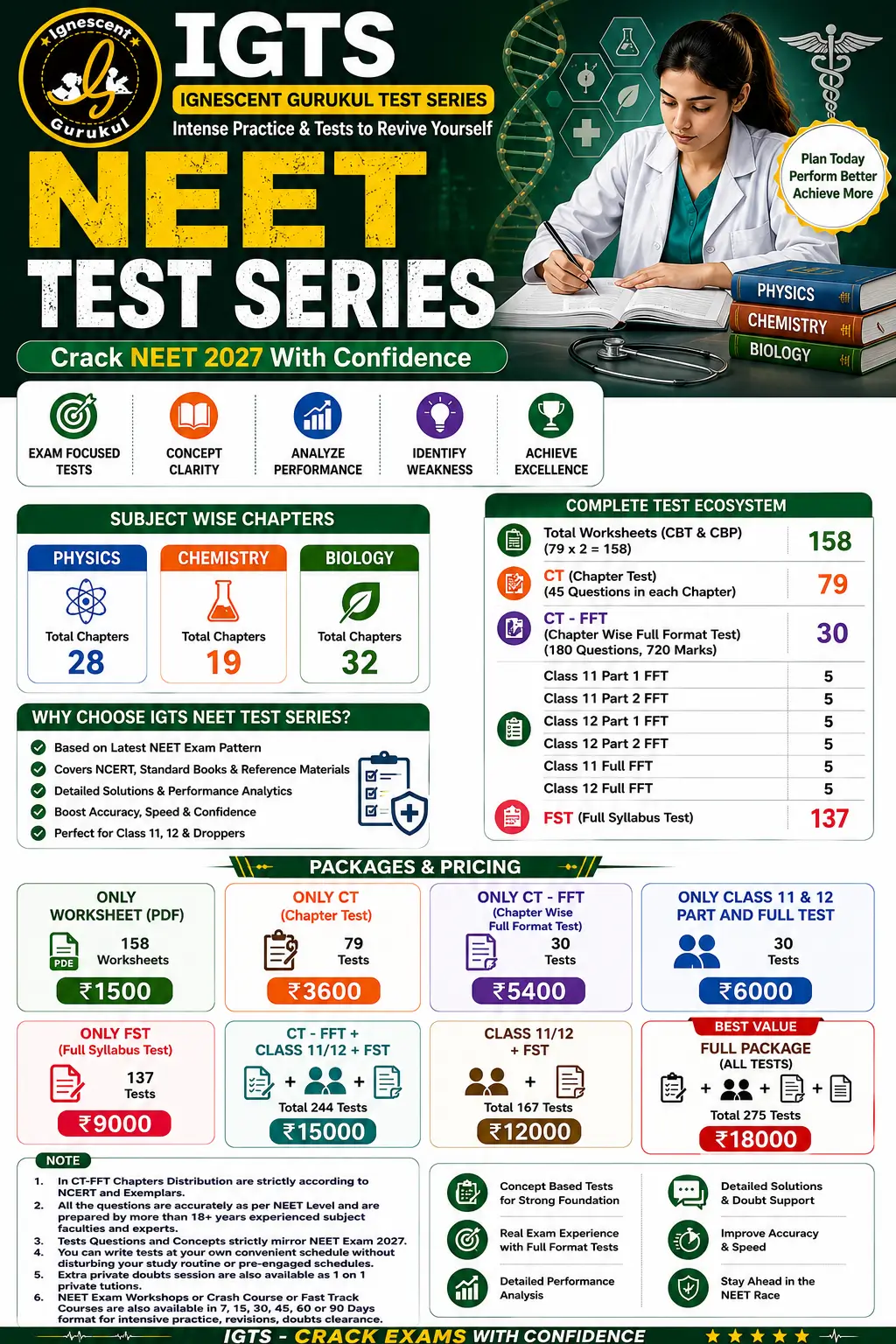
Mock tests should gradually move from topic-based assessment to complete exam simulation. A student who waits until the final weeks to attempt full papers loses the opportunity to build speed, accuracy and stamina gradually.
| Test Type | Purpose | When to Use |
|---|---|---|
| CBT | Check understanding immediately after taught topics. | Daily / frequent |
| Chapter Test | Check whether a complete chapter can be solved independently. | After chapter completion and revision |
| FFT | Practise full-format examination conditions. | Regularly during advanced preparation |
| FST | Develop full-paper stamina, time management and exam temperament. | Repeatedly during full-syllabus preparation |
| Customised Test | Attack specific weak chapters, concepts or recurring mistakes. | After performance analysis |
The detailed Ignescent Gurukul plan places substantial emphasis on CBT, FFT, FST and customised testing throughout the academic cycle rather than treating tests as a final-stage activity. :contentReference[oaicite:8]{index=8}
How the 60 Days NEET Workshop Fits Into the 2027 Plan
The January-February phase of the proposed plan is structured as a 60 Days NEET Workshop with 540 planned hours. The stated objective is intensive practice, NCERT and PYQ work, testing, doubt resolution, accuracy improvement and time management. :contentReference[oaicite:9]{index=9}
This period should be treated as an acceleration phase rather than starting preparation from zero. Students should enter it with enough conceptual foundation to focus heavily on practice, revision and testing.
A Good 60-Day Routine
- Rapid chapter revision
- Intensive NEET-level question practice
- NCERT and PYQ reinforcement
- Frequent full-format and full-syllabus testing
- Error analysis after every test
- Targeted doubt clearing
- Continuous time-management practice
How the 30 Days NEET Workshops Fit Into Final Preparation
The proposed March and April phases each contain a 30-day intensive workshop. The first is designed around chapter-by-chapter rapid practice and CBT-based correction, while the second emphasises intensive revision, NCERT/PYQs/CFQs and score improvement. :contentReference[oaicite:10]{index=10}
At this stage, students should avoid starting an endless cycle of learning new material. The priority becomes:
- Revise repeatedly.
- Test under time limits.
- Analyse mistakes.
- Fix recurring errors.
- Strengthen high-value concepts.
- Maintain accuracy while increasing speed.
How to Handle Backlogs While Preparing for NEET 2027
Backlog management is one of the most important parts of a realistic NEET preparation strategy. Students often make the mistake of stopping their current preparation completely until every old chapter is finished. That can create a second backlog.
Use the 3-Level Backlog Method
Level 1 — Critical: Topics that prevent you from understanding current chapters.
Level 2 — Important: Completed chapters where your question-solving ability is weak.
Level 3 — Revision: Chapters you understand but cannot yet recall or solve consistently under time pressure.
Work on the critical backlog first while continuing the current academic schedule. Then attack important weak areas through planned practice and finally use revision/test cycles to maintain previously covered content.
The Most Important NEET Preparation Habit: Error Correction
A test score alone does not explain why a student is underperforming. Two students can both score 500 but have completely different problems. One may lack concepts; another may make careless errors; another may lose marks because of time management.
After every meaningful test, classify mistakes into categories such as:
- Conceptual error
- Formula or fact forgotten
- Calculation error
- Misreading the question
- Guessing
- Time-management problem
- Careless marking error
Then retest the same concept after correction. This closes the gap between “I studied this chapter” and “I can solve questions from this chapter under exam conditions.”
How to Plan the Final Stage Before NEET 2027
The final stage should not become a period of panic. By then, most students should be moving through revision, full-paper practice, error correction and confidence-building rather than trying to learn the entire syllabus for the first time.
Final Revision Priorities
- NCERT-marked and repeatedly tested concepts
- Physics formulas and common application patterns
- Chemistry reactions, concepts, calculations and NCERT facts
- Biology terminology, diagrams and high-frequency factual areas
- Personal error notebook
- Full-syllabus mock tests
- Time management and paper-attempt strategy
- Sleep, routine and examination temperament
The proposed Ignescent Gurukul plan uses its own academic dates and phases. The official NEET 2027 application, examination date, information bulletin and other regulatory details must be checked on the NTA website when officially released. :contentReference[oaicite:11]{index=11}
Who Can Use This NEET Preparation Plan?
A structured plan can be useful for different types of NEET aspirants, provided the workload is adapted to their current academic level.
- Class 11 students beginning serious NEET preparation
- Class 12 students balancing Boards and NEET
- Freshers who need a complete structured roadmap
- Droppers and repeaters who need intensive revision and testing
- Students with significant backlogs
- Students who understand concepts but need much more practice
- Students who need regular testing and performance analysis
A Practical Weekly NEET Study Model
A student may adapt the exact timetable according to school, coaching and individual circumstances, but a useful weekly rhythm can look like:
| Day | Primary Focus | Assessment |
|---|---|---|
| Monday | Concept learning + examples + practice | Topic test / CBT |
| Tuesday | Concept learning + problem solving | CBT + error review |
| Wednesday | Concepts + mixed questions | CBT |
| Thursday | Practice + weak-area correction | CBT |
| Friday | Weekly consolidation | Revision test |
| Saturday | Full-format practice | FFT / equivalent full-format test |
| Sunday | Full-paper practice / analysis / revision | FST / full-syllabus test when scheduled |
The exact weekly structure should be adapted to the student’s actual class schedule and the programme enrolled in. The detailed Ignescent Gurukul 2027 plan proposes weekday teaching and testing followed by FFT/FST-oriented weekend assessment. :contentReference[oaicite:12]{index=12}
What Should You Do After Making Your NEET 2027 Plan?
A plan becomes useful only when it becomes a routine. The next step is to convert the roadmap into daily academic actions:
- Decide the current preparation level.
- Identify unfinished and weak chapters.
- Allocate realistic daily study hours.
- Schedule question practice every day.
- Begin regular CBTs and chapter tests.
- Schedule full-format and full-syllabus tests progressively.
- Review mistakes after every important test.
- Revisit completed topics through planned revision cycles.
Students should also avoid changing their preparation strategy every few days. Consistency, testing and analysis are generally more useful than continually searching for a “perfect” new timetable.
Need a Structured NEET 2027 Preparation Plan?
Ignescent Gurukul offers NEET preparation through structured concept teaching, practice-based classes, daily Concept Based Tests, mock-test preparation, revision programmes and focused workshops. Students can enquire about full NEET preparation as well as Physics, Chemistry and Biology separately.
Frequently Asked Questions About NEET Preparation Plan 2027
When should I start preparing for NEET 2027?
How many hours should I study for NEET 2027 every day?
Is NCERT important for NEET preparation?
Should I solve NEET PYQs during preparation or only at the end?
How often should NEET mock tests be taken?
What is the benefit of a 60 Days NEET Workshop?
Can a NEET dropper follow this preparation strategy?
Is the NEET 2027 examination date officially confirmed?
Official NTA NEET (UG) Website | NMC NEET-UG Syllabus Resource